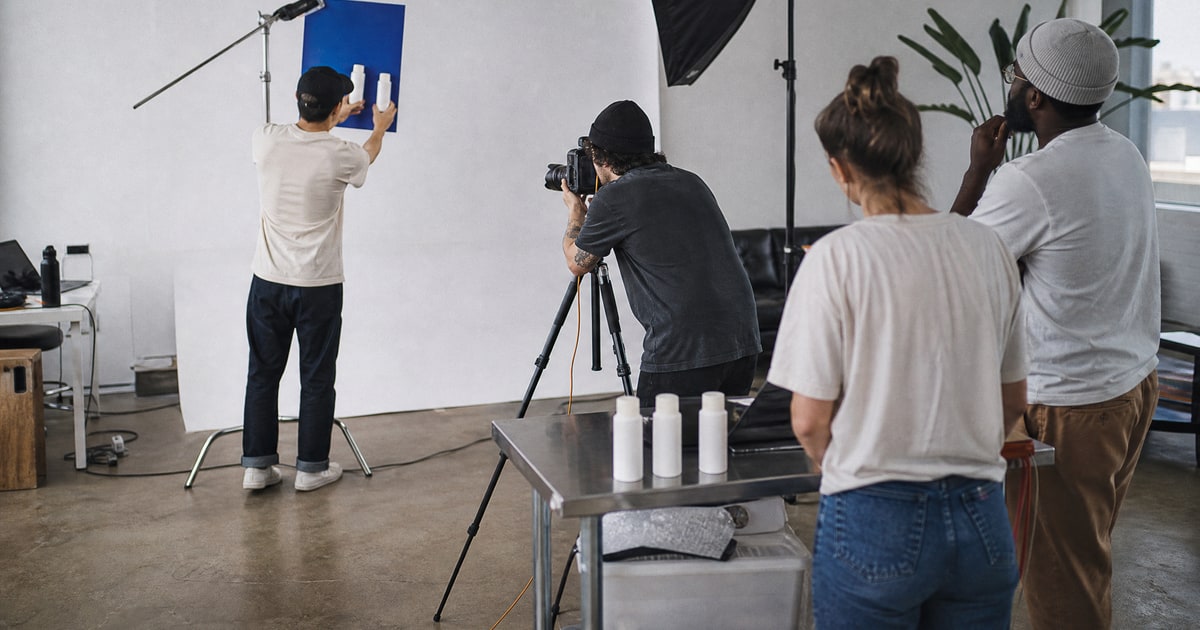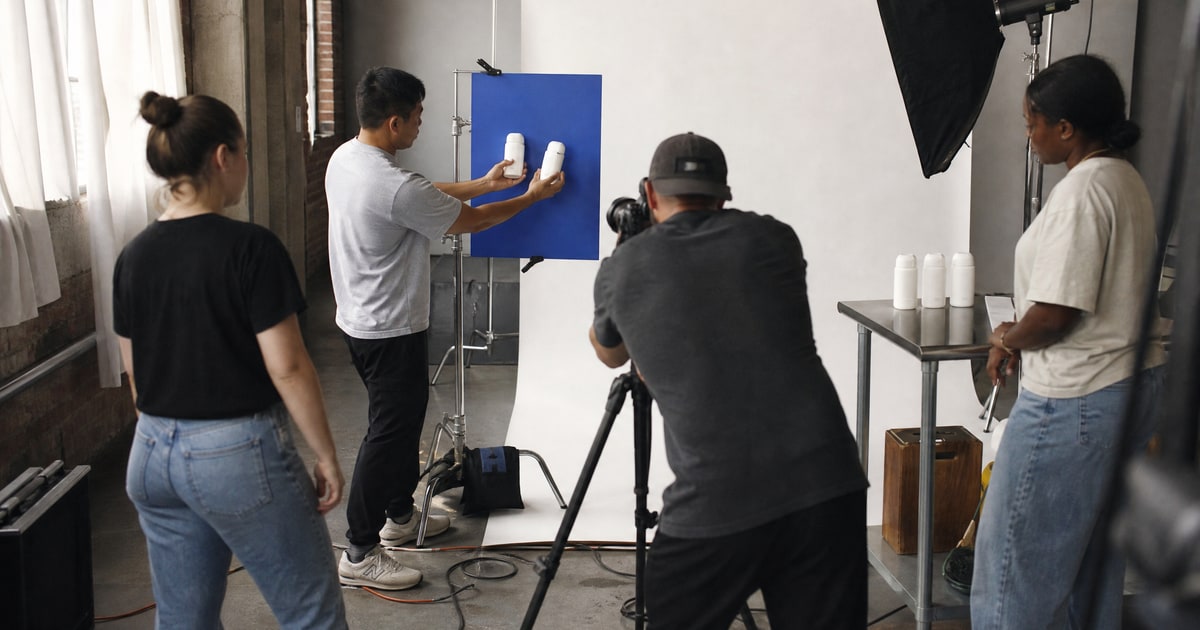
You need four things to shoot usable Amazon product clips at home: a phone with a decent camera, a tripod, one large diffused light source, and a plain sweep backdrop. Everything else is optional. Spend your remaining budget on knowing what the clip must prove, because research quality beats production quality on Amazon.
The short version
- Light decides quality; the camera mostly decides file size. A recent phone behind good light beats a cinema camera behind bad light.
- Stability is the cheapest professionalism. Handheld wobble is the fastest way to look like a scam listing.
- The backdrop removes your apartment from the frame. A sweep of white paper is a studio as far as the shopper knows.
- Sound is optional until it is not. Text overlays carry most listing clips; buy a microphone only when a voice earns its place.
- The script outranks the kit. Know the one claim your clip must prove before you press record.
The camera myth, and what actually shows on screen
Amazon clips play in a small window to a shopper who is comparing five products at once. At that size, resolution differences between a phone and a professional camera are invisible, but three other things are glaring: wobble, murky lighting, and a clip that takes eight seconds to reach the point. All three are fixed by cheap equipment and a written plan, none by a better sensor. That is the entire economics of home shooting, and it is why our own creative team briefs shot lists harder than it briefs equipment.
The kit, in the order it earns its keep
- The phone you already own. Any recent model shoots better footage than the platform will ever display. Lock exposure and focus before rolling, and wipe the lens, which fixes more "blurry video" complaints than any purchase.
- A tripod with a phone mount. Stability separates trustworthy from amateur instantly. It also makes repeat takes framable in exactly the same way, which you will want when stitching cuts.
- One large diffused light. A softbox or a big LED panel bounced off a white wall. One source, close to the product, kills the harsh shadows that make plastic look cheap and metal look gray.
- A paper sweep backdrop. A roll of white or neutral paper curving from wall to table. Your kitchen disappears; the product becomes the only subject in the frame.
- Optional extras, bought on evidence. A clip-on macro lens if texture is your selling point, a lavalier microphone if a human explains the product on camera, a cheap turntable if the product reads better in rotation. Buy each only when a specific frame in your script demands it.
The arithmetic that should decide your setup
| Cost line | What it buys | When it is worth it |
|---|---|---|
| Basic kit above | Competence: stable, lit, clean frames | Always, for any self-shot clip |
| Optional extras | One specific frame each | Only when the script names the frame |
| Your hours | Scripting, shooting, editing, re-shooting | Early stage, low volume |
| Outsourced production | Someone else's hours and judgment | When your hours are worth more elsewhere |
The line most sellers misprice is the third one. During a launch our clients typically put in four to six hours a week even with us executing everything; add self-shot video on top and you are the bottleneck for your own listing. Gear is a one-time cost. Your attention is a recurring one.
Decide what the clip proves before you press record
This is where home shooters actually lose, and no purchase fixes it. Before we produce creative for any product, our research runs across 90+ data points on the market, market size, growth, return rates, segment dynamics, and the rating gap, and the differentiation we show on camera comes from competitor negative reviews rather than from anyone's imagination. You can run a lean version of this at home in an afternoon: read the one-star and two-star reviews of the three products you most want to beat, list the complaints that repeat, and script your clip to disprove the loudest one inside the first two seconds.
A clip built this way, shot on a phone, outsells a beautiful film that proves nothing. The video is also only one slot in the gallery, so treat it as a piece of listing optimization rather than a production milestone.
What gear guides will not tell you
Most gear roundups are affiliate catalogs, paid a commission on every camera body and light they persuade you to buy, so the recommended kit grows every year while the platform's playback window does not. The honest version of a gear guide is short, which makes it bad affiliate business.
The second omission: the upgrade that moves conversion is almost never equipment. It is the script, the first two seconds, and captions, because a large share of shoppers watch muted. If your clip fails silently, no lens will save it.
Related answers
- Alternatives to hiring a full-time videographer for Amazon
- Step-by-step workflow to produce Amazon listing videos
- Affordable Amazon product demo video creators
- Alternatives to DIY Amazon product photos
- Amazon creative services: the complete guide
When you would rather spend those hours elsewhere, the studio is already staffed at Flapen.