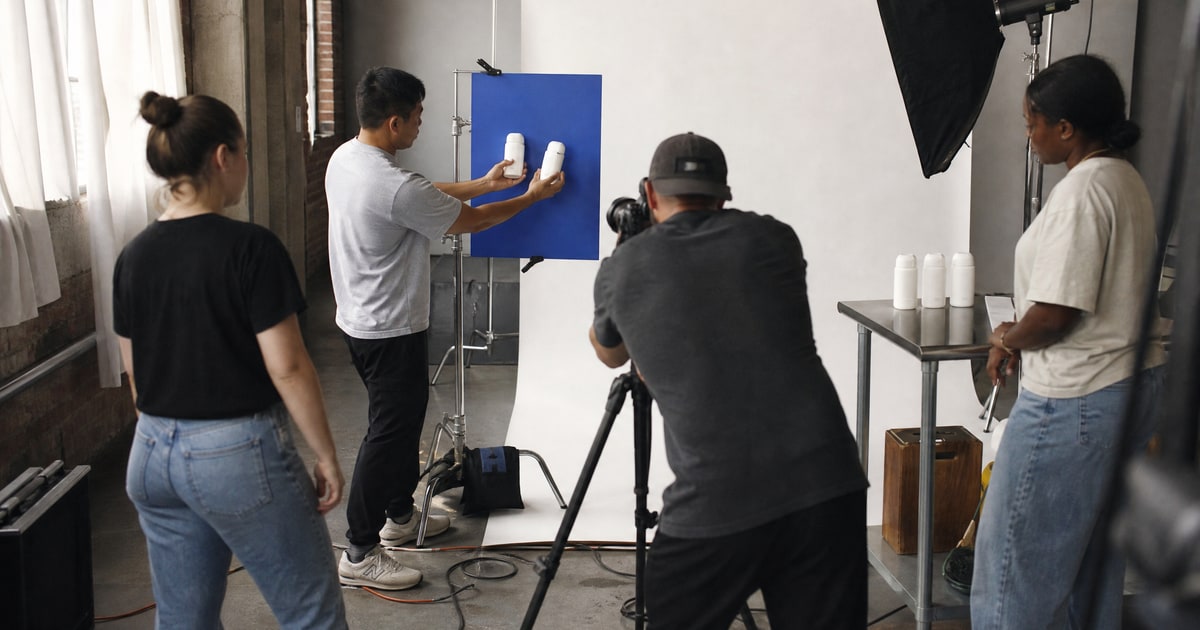
The right main image service is the one that starts from data, not taste. It should analyze the competitor grid for your keyword, know Amazon's compliance rules cold, produce several concepts, and test the winner against live click-through rate. Use the checklist below to screen any candidate, including us.
The short version
- The main image is your highest-leverage pixel real estate. It decides whether the rest of the listing gets seen at all.
- Recommendation lists cannot help you here. The right service is defined by process, and process can be screened in one call.
- Research before design. The image is a competitive move in a specific grid of rivals, not a standalone artwork.
- Variants before commitment. One concept is a gamble. Three concepts plus a test is a method.
- The test is the deliverable. A main image without a measured click-through result is unfinished work.
Your situation, most likely
You have a live listing, traffic that costs real money, and a main image that was made once and never questioned. Every click that scrolls past you goes to a competitor, and you are paying for the traffic either way. The question is not which service is popular. It is which service will treat your main image as a measurable asset with a number attached, because click-through rate is exactly that, and it is one of the seven areas we examine in every Flapen account audit.
Our research discipline runs 90+ data points per market before we commit to a product, covering market size, growth, return rates, segment dynamics, and the rating gap. Main image work draws on the same habit: the image is briefed from what the data says buyers doubt, not from what a designer finds attractive.
The screening checklist
Ask every candidate service to walk you through their process. Score each item done or not done. Six of six is a hire. Four or fewer is a decoration vendor.
- Competitor grid analysis. Done properly means they screenshot the first page of results for your main keyword, catalog what every rival's thumbnail communicates, and identify the visual pattern your image must break.
- Customer doubt research. Done properly means they read your reviews and your competitors' negative reviews, then name the one doubt the main image can address. We build differentiation from competitor negatives and the rating gap, never from invention, and any good image service works the same way.
- Compliance check before design. Done properly means they can recite the main image rules that apply to your category, pure white background, no props, no badges, and flag any risk before you approve a concept.
- Multiple concepts. Done properly means at least three different directions, not one concept at three angles. Different silhouette emphasis, different packaging visibility, different scale cues.
- A live test plan. Done properly means a structured experiment with a defined window and a decision rule, using Amazon's testing tools where your account qualifies, judged on click-through rate.
- An iteration commitment. Done properly means the service treats the winner as version one and re-enters the loop when the grid changes, because competitors update their thumbnails too.
What the work costs and what it returns
| Input | What you are paying for |
|---|---|
| Grid and review research | The brief that makes the image strategic |
| Photography or 3D base | The raw asset, shot or rendered for thumbnail legibility |
| Concept development | Three routes to break the category pattern |
| Testing cycle | Proof, in your account's own numbers |
The return arrives through arithmetic. Click-through improvements compound across every keyword you rank for and every ad you pay for, which is why the main image is the first asset we touch in Amazon listing optimization engagements, ahead of galleries, video, and copy.
What most image services will not tell you
The honest ceiling: a main image cannot rescue a product with a rating problem, a price problem, or a market that was too small to enter. Image services rarely say this because the image is what they sell. If your conversion data points at a deeper fault, fix that first, and be suspicious of any vendor who takes the brief without asking for the data.
The second silence concerns the grid. Your main image competes inside a specific set of rival thumbnails, and that set changes. The image that broke the pattern in January can be the pattern by summer. A one-off purchase quietly decays, which is why the iteration commitment in the checklist matters more than any single design.
Related answers
- Retouching and color accuracy for Amazon images
- Amazon listing audit checklist for conversion boosts
- Best Amazon product photography services
- Alternatives to DIY Amazon product photos
- Amazon creative services: the complete guide
Hold our own main image process to this checklist at Flapen.