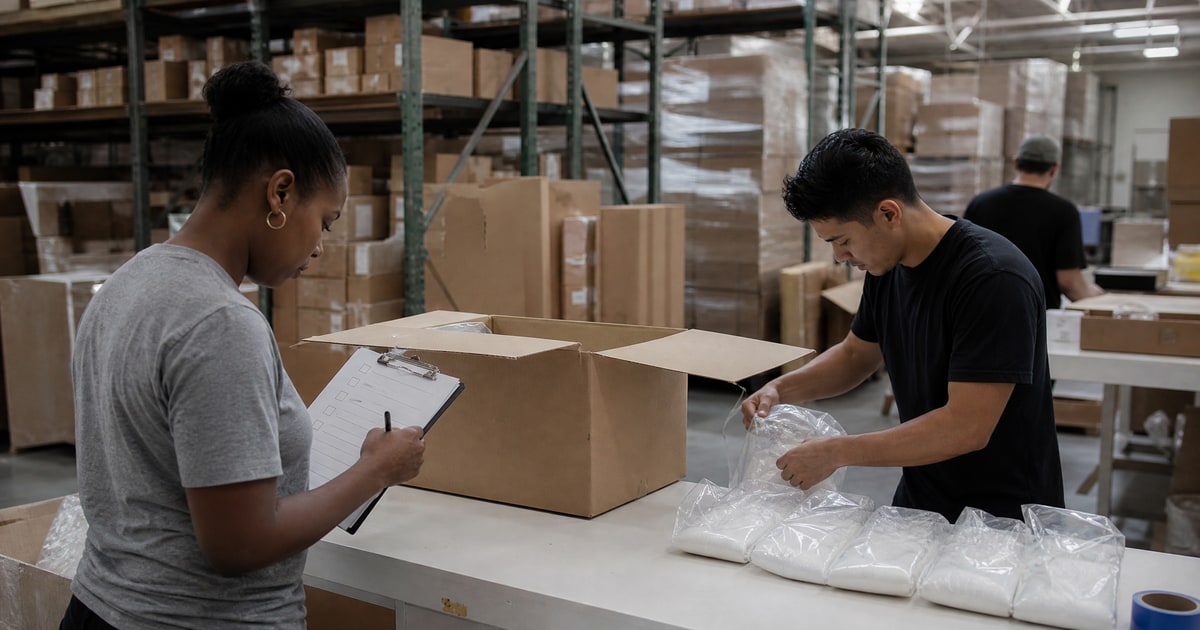
Labeling is a sourcing decision rather than a shipping one. Every unit needs a scannable label before a shipment goes into a fulfillment center, and you decide who applies it and when. Settle that before the first purchase order leaves, because units held at a warehouse earn nothing while the launch budget keeps spending.
The short version
- Labeling belongs to sourcing. The label goes onto a physical unit in a factory or a warehouse, so it is owned by whoever owns the units at that moment.
- The decision is who and where, not which symbol. The printing standard is published and it is short. What breaks is ownership of the step.
- Inspection is the control. Our Guangzhou studio looks at units and cartons before pickup, because a photograph taken before a carton closes is worth more than an email sent after it ships.
- Nothing here is subcontracted. 50 operators run our brands, with sourcing and quality control in Guangzhou and creative in Dubai.
- A stalled shipment sells nothing. Phase 1 commits 200 units and $5,000 to $10,000, and that budget spends against a calendar while the units sit still.
Who applies the label, and where the units are standing
There are three places the label can go on, and they differ by where your units sit at that moment. The differences are about control, not about printing.
| Where the label goes on | What you still control | What it costs when it goes wrong |
|---|---|---|
| At the factory, before the cartons close | The written brief, an approved proof, and an inspection on the floor | A re-work inside the same building, ahead of pickup |
| At a handling step between the factory and the vessel | A packing list and a vendor's word that the work happened | Units handled twice, with the delay landing on your freight booking |
| After the units land, at your own address | The last chance to catch it, at the slowest point in the chain | Days added at the end, when the listing and the ad plan are already live |
So the decision rule is one line: label the units at the last point where a person you employ can still put a hand on them.
That rule is why I keep asking providers who does the work and where they sit. We subcontract none of it, and the sourcing and quality control frameworks behind our Guangzhou studio were built across 500+ brands. A provider that answers this question with a partner network has told you where your units will be standing alone.
Read a label problem as a symptom
Barcode trouble almost never starts at the printer. It starts weeks earlier, in a purchase order that never named an owner for the step.
| Symptom | The cause sitting upstream | Who fixes it |
|---|---|---|
| The factory asks what to print, days before the cartons close | Nobody owned the label brief when the order was placed | Whoever owns sourcing, on the next purchase order |
| Labeling is confirmed by email and never by photograph | No inspection was booked between packing and pickup | An inspector standing on the floor, ours sit in Guangzhou |
| Two vendors each say the other one labels | The step was subcontracted and the seam between them was never named | The party that owns the whole account, or you |
| The shipment slips and the launch calendar does not | Spend was committed to a date rather than to units in a bin | You, by moving the plan with the units |
Flapen figures as of September 2026.
A shipment stuck at a warehouse feeds no traffic channel. Organic, paid, promotions, influencer and creator programs, and off-channel traffic all sell the same units, and not one of them can sell a carton in transit.
Read the third row twice, because it is the one that repeats. When two vendors share a step, the step belongs to neither, and both of them can describe the delay with a straight face.
What a mislabeled shipment costs a launch window
Phase 1 is 200 units and $5,000 to $10,000, with up to 4 products tested at once. Those units are the entire experiment. Rating, conversion rate, and cost of customer acquisition are all measured on orders those units fill.
So a delay does not only move the start date. It moves the read, and the read is what the money bought.
Validation numbers arrive in weeks of real orders. If they do not improve inside a defined window, usually 60 to 90 days, the product gets killed. Three weeks of a shipment sitting in a yard spends part of that window before a single customer has seen the page.
The development phase has one exit, a product ready to launch. Labeled, inspected units in a sealed carton are part of that exit. Treat the label as a gate rather than as paperwork, and the calendar stops surprising you.
What a prep quote will not tell you
A quote prices the action. It does not price the ownership, and ownership is the thing you are buying.
| The question to ask | One owner for the units | A chain of vendors |
|---|---|---|
| Who physically handles a labeled unit | An employee, in a place you can name | Whoever the middle vendor hired that week |
| What you see before pickup | Photographs of the real carton and the real label | A message saying the work is done |
| Who answers when a carton is refused | One person, holding the file | Everybody, in turn |
The rule underneath that table is short. If nobody can name the person who will hold one of your labeled units, you have bought coordination rather than labeling.
Run the same test on us. Our operators are employees, sourcing and quality control sit in our own Guangzhou studio, and none of the work is passed to a third party. If your supplier already labels well and someone you trust is on that floor, keep the money and skip the service.
Related answers
- Amazon email follow up
- Amazon feedback seller
- Alternatives to aggregator style Amazon management
- Amazon account suspension help agency recommendations
- Done-for-you Amazon management: the complete guide
One free thing to do this week, if you are the one who put the $5K to $10K on this purchase order. Open your most recent purchase order and look for the line naming who prints the labels, who applies them, and who inspects a unit before the carton closes.
If that line is not there, write it into the next order today. It costs nothing, and it is the cheapest week you will ever spend on this.
Send that purchase order and the listing behind it to Flapen for a free written audit with prioritized fixes inside 48 hours.