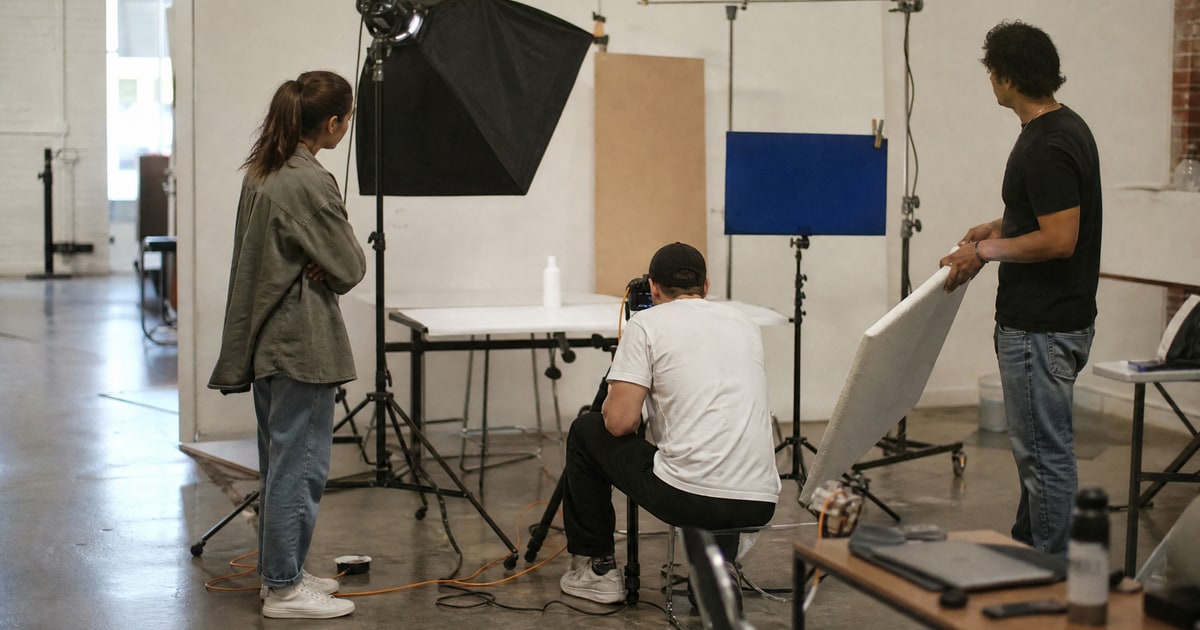
The images, video, and A+ content on an FBA listing form one deliverable with one owner, and the brief comes from the market rather than from taste. Buyer complaints decide what the product must show, and market size decides what the shoot is worth. Your validation stage decides when you pay for it.
The short version
- One deliverable, one owner. Images, video, A+ content, and the store answer one question in sequence, so splitting them across vendors splits the answer.
- The brief is written from complaints. Read the negative reviews of what already sells, then build for 0.2 stars above the niche average.
- The primary image is measured first. Primary image click-through rate sits on our audit list, and it decides whether the rest is ever seen.
- Phase 1 caps the spend. Validation runs 200 units on $5,000 to $10,000, and creative is a line inside that budget, not a project beside it.
- Ownership is a contract term. Deliverables become client IP on full payment, so settle who holds the raw files before you pay.
Start from the symptom, not from the shot list
The line that sends most sellers to this search is "My product is live but sales are not where they should be." By the time it is typed the photography has already been blamed. For a seller running one to three products at $5,000 to $30,000 a month, that guess is expensive in both directions.
| Symptom | What is behind it | Who fixes it |
|---|---|---|
| Sessions hold and conversion does not | No complaint went into the brief, so the images answer a question nobody asked | Your brand manager, rewriting the brief before a camera is booked |
| Impressions climb and clicks stay flat | The primary image loses the search grid, so nobody reaches the page | Whoever owns the listing, testing the primary image alone |
| The rating sits at or under the niche average | A product complaint is being photographed instead of fixed | Sourcing and product, ahead of any reshoot |
| The set looks excellent and sales stay flat | The market underneath is too small to repay any asset | You, by sizing the market before the next invoice |
Flapen figures as of September 2026. The middle column is a diagnosis, not a service.
Two of those four rows are solved by a camera. The other two are solved upstream, by whoever owns the account rather than whoever owns the lighting. That is the argument for putting creative inside management, not alongside it.
What a creative brief is built from
We do not differentiate through creativity or bundling. We read the negative reviews of everything already selling, measure the rating gap, and build for 0.2 stars above the niche average. The market tells you where to innovate, so you do not guess.
A creative brief is an output of that research, never an input to it. We put 90+ data points behind a launch decision, and the complaints that repeat inside them set the order of the images. The frustration a buyer writes down twice is the frame you shoot first.
Primary image click-through rate sits on our audit list beside listing quality, conversion rate, ad performance, traffic channel activation, pricing, and return rate. It is the one creative number readable on its own, decided before your page loads. Move it first, then judge the rest of the set against a page buyers reach.
What a listing accepts differs by category and by account. Confirm the current image and A+ content requirements inside your own Seller Central before anyone books a studio day. A reshoot caused by a requirement nobody checked is the most avoidable cost here.
What creative is worth at your stage
Creative spending is sized by the market, not by the quote. A market has to turn over $2M per year before it is worth entering. Below that there is not enough revenue to capture profitably after the cost of customer acquisition.
Then it is staged. Phase 1 validates with 200 units and $5,000 to $10,000, and the creative you need there is the set that lets the product be judged. Phase 2 commits real capital only once rating, conversion rate, and cost of customer acquisition are proven.
Our own work comes out of an in-house creative studio in Dubai, staffed by employees, with nothing subcontracted. Deliverables become client IP on full payment. On exit you keep the account, the campaigns, and the creative, plus a written handover, on 30 days' notice. Put both questions to every studio you shortlist, then read the contract instead of the answer.
What a creative package will not tell you
Four things stay outside the creative pitch, and on a bad day that includes ours. Each shows up in the proposal, so this table reads like the first.
| What you see in the pitch | What is behind it | Who fixes it |
|---|---|---|
| A price per asset and no question about your market | The quote was built from studio hours, which know nothing about market size | You, by applying the $2M floor before booking the shoot |
| A shot list with no complaint attached to any frame | Nobody read the negative reviews, so the set is decoration | Whoever holds the research, rewriting the brief in an afternoon |
| Beautiful work and no baseline for the page it replaces | Without a before number, nobody can be held to an after number | You, by recording conversion rate and primary image click-through rate first |
| The raw files stay with the studio | The default is a license to the finished export | The contract, agreed before payment rather than after it |
Flapen figures as of September 2026. The last row is settled in writing or not at all.
Hold us to every line of that. Our fee is flat at $800 a month for one product with no commission on your sales, and the creative is produced by our own team. If the market under your product cannot clear the $2M floor, no studio is the right purchase, ours included.
Related answers
- FBA definition on Amazon
- Amazon FBA consulting
- Amazon account management for global sellers
- End to end Amazon catalog optimization services
- Done-for-you Amazon management: the complete guide
One free thing to do this week, for a seller running one to three products at $5,000 to $30,000 a month. Open the negative reviews of the three best sellers in your niche and paste every one-star and two-star comment into a sheet. Sort by the complaint that repeats most, then count how many of your current images answer it.
Most sets answer none of the top three, and that count is your creative brief.
To have that count read against your listing and your primary image click-through rate, request the free written audit. It returns prioritized fixes inside 48 hours, from Flapen.