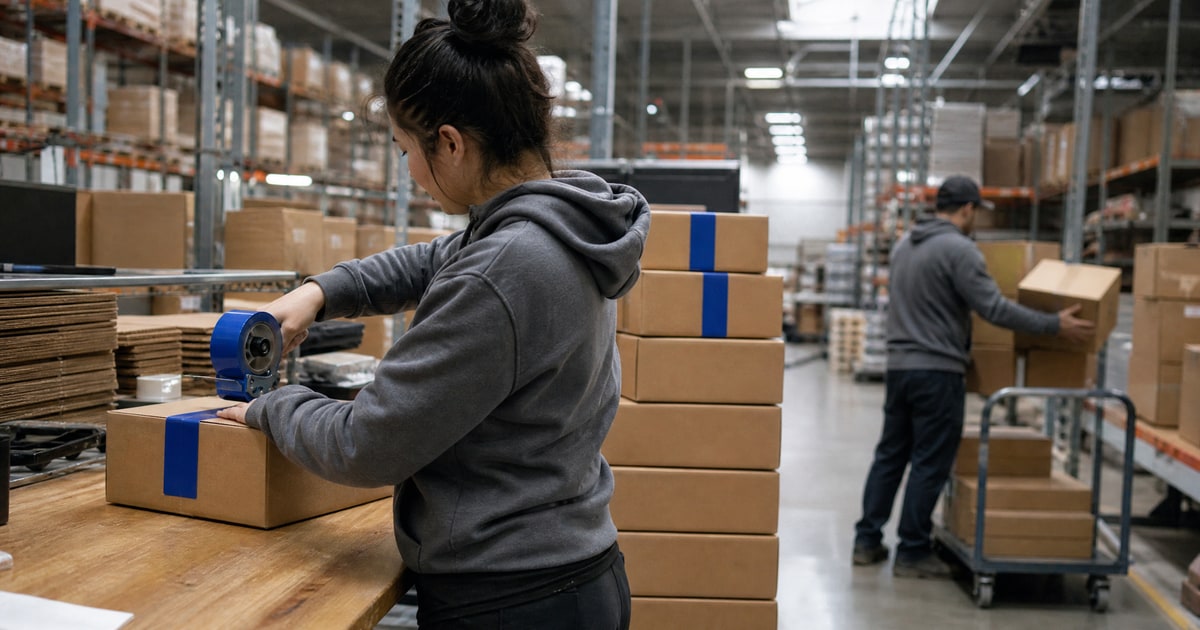
Your box has three jobs before it has a design: survive transit, carry the brand, and fit the unit economics. One named person owns that spec and signs it before the first purchase order. Confirm every requirement inside your own Seller Central account, because a rule read on a blog is not a rule.
The short version
- The box has one owner, and it is not the factory. A supplier ships the pack it already runs unless somebody writes a spec and signs a sample.
- Compliance is confirmed in your own account, never from an article. What a marketplace asks of your unit differs by category and changes, so read it where it applies.
- Damage and returns are the weekly read. We hold market entry to a return rate under 8%, and a pack that fails in transit shows up there first.
- Phase 1 sizes the packaging bill for you. Validation runs 200 units on $5,000 to $10,000, so multiply your own per-unit pack cost by 200 and you have the number.
- Two aggregators put me on the buying side of this work. At BRANDED and Moonshot Brands I audited 60+ acquired brands doing $5M to $10M each, and the pack was rarely anyone's job.
What the agencies I hired left out of the packaging brief
I bought this kind of service for years before I sold it. Running data and technology at two large Amazon aggregators, BRANDED and Moonshot Brands, I inherited brands with vendors already in place. Their service decks named listings, advertising, and creative, and not one of them named the box.
So the box stayed with whoever placed the last order, which was almost always the factory. That is a fair default for the supplier and a poor one for the brand, whose unit is opened weeks later.
Sellers running one to three products at $5K to $30K a month bring me the same sentence: "My product is live but sales are not where they should be." When the listing converts and the advertising is honest, the physical unit is one of the few places left to look. Damage complaints sit in returns and cost nothing to count.
Three questions were missing from every scope I inherited. Who signs the sample, who reads damage against returns each week, and who reprices the pack at the reorder. Put all three to any candidate in writing.
Supplier default pack against a pack you specify
The choice is not branded against plain. It is whether a named person decided the pack, or whether the factory filled that gap.
| Question to settle | Supplier default pack | A pack you specify |
|---|---|---|
| Who writes it | the factory, from the tooling it already runs | you, or the operator you pay to own the spec |
| When damage gets priced | after a customer reports it in a return | before the first purchase order, on a signed sample |
| What a change costs | a replacement run, plus the ratings already earned | one sample round inside the 200 units of Phase 1 |
Flapen figures as of September 2026. Your per-unit pack cost is the one number here that only your supplier can set.
So run the default while 200 units are still proving the product, and specify the pack before Phase 2 capital goes to the factory.
The brand half of the job arrives later than sellers expect. A box earns its design budget once the unit survives the trip and returns hold under 8%.
Who owns the spec here, and what gets read every week
Sourcing and quality control run through our own Guangzhou studio, on frameworks built across 500+ brands, and none of it is subcontracted. The creative studio in Dubai draws what goes on the box. One operator signs the spec, and the same operator writes your weekly update.
The read is written down rather than remembered. A written update lands in Slack every week here, with a live review every two weeks. Two of its lines belong to the pack: damaged units in this week's returns, and the return rate against the 8% bar.
Compliance stays where it can be verified. Every packaging and labeling requirement is confirmed inside your own account before the first shipment, by the spec owner. A list on a page cannot know your category, your unit, or your marketplace.
The stop rule is written before any of it. Kill Criteria reads four signals: rating trend, return rate, conversion rate, and cost of customer acquisition (CAC) trajectory. If a pack change moves neither damage nor the return rate inside 60 to 90 days, stop buying boxes and go back to the product.
What most agencies will not tell you about packaging
Packaging is unglamorous, hard to bill from a deck, and it moves the number that decides margin. That is why it falls off scopes.
| The packaging job | You own it | Inside a managed spec |
|---|---|---|
| Signing the sample before the run | your hours, and one honest look at a dropped unit | a named operator in Guangzhou, inside the fee |
| Reading damage against returns weekly | your calendar, every week | two lines of the weekly update, from $800 a month |
| Changing the pack after a bad month | a supplier conversation started cold | an open supplier relationship, on frameworks from 500+ brands |
Flapen figures as of September 2026. The hours column is yours to price, and most sellers price it at zero.
So own the pack yourself while one product is in validation, and buy the spec once damage costs more per month than the tier.
Two more things stay out of most pitches, and on a bad day out of ours. A better box does not rescue a product the market did not want, and a spec you cannot check on arrival is not yours. Scale / Fix / Kill puts the pack in the fix column, never the scale column.
Hold us to the same test. Our fee is flat, $800 a month for one product and $1,500 for three, every service included, no commission. If your supplier already ships a pack that survives and returns sit under 8%, keep the money.
Related answers
- Amazon FBA seller
- Remote fulfillment with FBA
- Full-service Amazon partner for D2C brands
- Recommended Amazon brand manager for global expansion
- Done-for-you Amazon management: the complete guide
One free thing to do this week, whether you run one product or three at $5K to $30K a month. Order a unit of your own product to your own address, open it the way a customer does, and photograph each step.
Then pull the last 30 days of returns in your own account and count how many mention damage or a missing part. That count and the photo set are the packaging brief you never wrote.
Request the free written audit and get prioritized fixes on that pack, your returns, and the listing back inside 48 hours at no charge from Flapen.