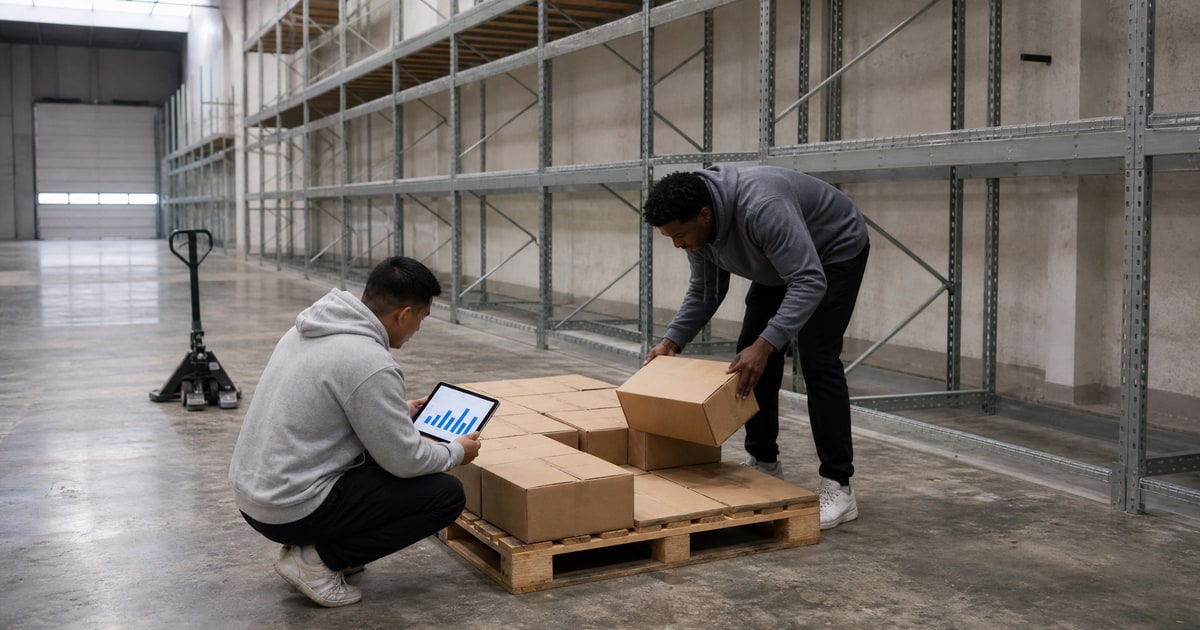
Manage prep and compliance from Asia with three controls: an inspection before the factory gets paid its balance, prep done at origin against Amazon's labeling and packaging requirements, and a document file per SKU holding every certificate customs or Amazon could request. Failures cluster exactly where those three controls are missing.
The short version
- Origin prep is cheaper than domestic prep. Labor cost does the work, but only if someone audits the output.
- The inspection is your only leverage. After the balance payment clears, requests become favors.
- Compliance documents are collected before the PO, not after the seizure. A missing certificate stops a container.
- Labels are binary. A barcode that scans is inventory. A barcode that does not is a stranded pallet.
- Ranked by cost, compliance failures beat everything else on this page. Plan in that order.
The five failure modes, ranked by cost
You are seven time zones from the factory, the goods will cross at least one border, and Amazon will only receive what matches its rules. Everything that goes wrong from that position fits into five buckets. Here they are, most expensive first.
| Rank | Failure | What it costs | The control that prevents it |
|---|---|---|---|
| 1 | Compliance failure, missing or wrong certificates | Seized shipments, destroyed stock, suspended listings | Certificate file per SKU, complete before the PO is signed |
| 2 | Stockout from a prep bottleneck | Every sale, from every channel, until stock returns | Prep capacity booked when the order is placed |
| 3 | Labeling errors | Stranded inventory, relabeling fees, lost weeks | Barcodes applied at origin, verified at inspection |
| 4 | Quality drift | A slow rating slide that ads cannot outrun | Inspection on every order, not only the first |
| 5 | Carton and pallet violations | Check-in delays and receiving refusals | Amazon's packaging requirements attached to the PO |
The second row deserves a number. A listing can draw traffic from five channels, organic, paid, promotions, creators, and off-channel, and most sellers only ever run two. A stockout is the one event that switches off all five at once, including the two you actually built. That is why a prep bottleneck, which sounds like a warehouse inconvenience, ranks above labels and quality here.
Who should do the prep
Three options, in rising order of cost. The factory itself preps cheapest, and does it exactly as well as the last person who checked. An origin prep partner adds a fee and a second set of hands between production and freight, which is where I want errors caught, before the goods cross an ocean. A domestic prep center near the fulfillment network costs the most per unit and is best kept as the correction layer for mistakes that slipped through, not the plan.
Our own answer is geographic. Flapen's sourcing studio sits in Guangzhou, so the people writing our purchase orders can stand next to the line that fills them, and prep gets audited in person rather than by photograph. You do not need my org chart to copy the principle: whoever preps, someone who answers to you verifies it at origin.
What most prep centers will not tell you
The per-unit quote covers the happy path. Rework, repacking, remeasuring, and storage while a problem waits for your decision are all billed separately, and a messy inbound shipment can double the effective rate. Ask for the exception price list up front, then judge quotes by what your worst shipment would cost, not your best.
Factory prep has its own silence: nobody at the factory is paid to tell you the carton spec changed. Amazon updates requirements, the factory reuses last year's dieline, and the fee for that gap lands on you at check-in.
Related answers
- Global lead times and shipping costs for Amazon restock
- What to use for China to Amazon warehouse logistics
- Compare 3PL vs sourcing agent for Amazon brands
- Amazon private label sourcing checklist
- Amazon seller roadmaps and capital: the complete guide
Prep and compliance are among the stages we run end to end in every Amazon FBA launch, and ongoing management of both is standard at Flapen.