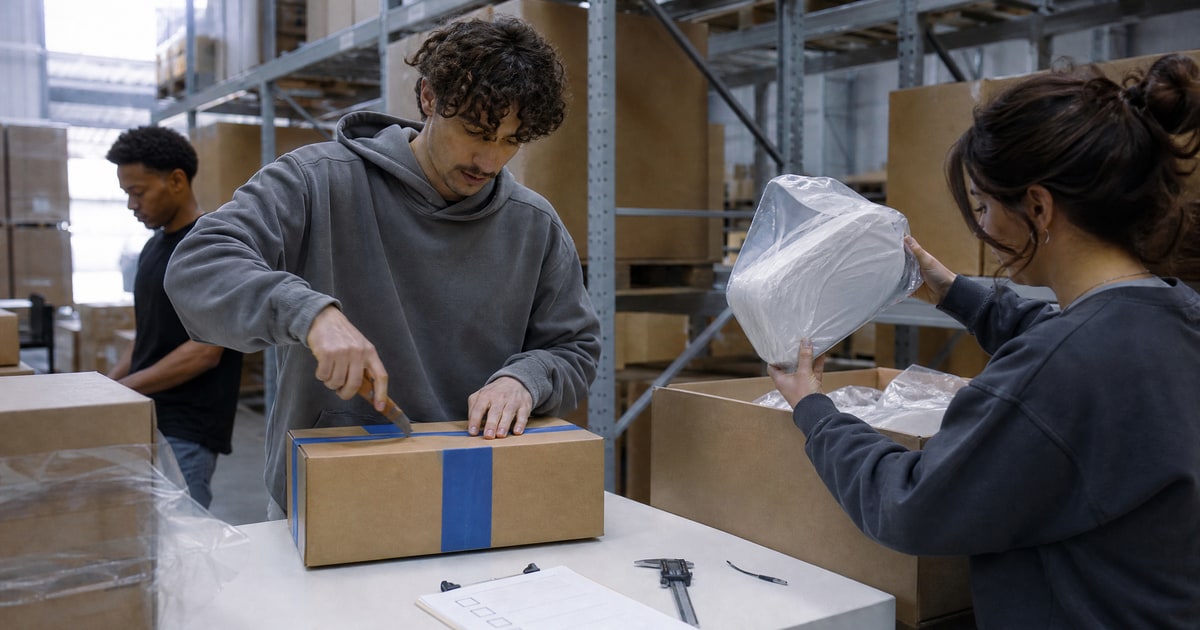
A sound sourcing workflow runs in order: validate the product decision, write a spec sheet, shortlist verified factories, sample against the spec, negotiate terms, run a small first production lot, inspect before balance payment, label at origin, then ship into FBA. Most failures are sequencing failures, steps done out of order or skipped.
The short version
- Sequence is the discipline. Nearly every sourcing disaster I have audited traces to a step performed early, late, or never.
- The spec sheet is the contract's spine. Without it, samples prove nothing and inspections measure nothing.
- First lots are for learning, not for unit economics. Size them to answer questions, not to minimize cost per unit.
- Labels go on at the factory. Destination prep is the expensive way to fix a planning miss.
- One owner per workflow. Every handoff between vendors is a place where accountability leaks out.
The nine steps, in the order that works
- Validate the decision. Confirm the market, the wedge, and the margin before contacting a single supplier. This step belongs to product research, and skipping it turns the remaining eight steps into efficient delivery of a mistake.
- Write the spec sheet. Materials, dimensions, tolerances, colors, packaging, and compliance marks, in one document a factory can quote against.
- Shortlist verified factories. Three to five makers, license-checked and screened for traders, quoting the identical spec so the quotes are comparable.
- Sample against the spec. Grade each sample line by line against the document from step two. Gut feel is not a grading system.
- Negotiate terms. Price matters less than structure: defect thresholds, payment milestones, tooling ownership, and rework obligations in writing.
- Run a small first lot. A modest production run that tests the factory at production speed, which is a different animal from sampling speed.
- Inspect before releasing the balance. An AQL-based check with photographs, contractually placed while you still hold payment leverage.
- Label and prep at origin. FNSKU, polybagging, and carton compliance at the factory, where the work costs a fraction of destination rates.
- Ship into FBA. Clean documents, correct Incoterms, and a delivery appointment that does not surprise anyone.
Plan for the full journey to take months, not weeks. Inside our own operation a complete brand launch runs about seven months end to end, and the sourcing chain above is the reason the later months go smoothly.
Where workflows break
Diagnose your own process against the failure table. Each symptom maps to a step from the sequence being skipped or reordered.
| Symptom | Root cause | The repair |
|---|---|---|
| Launch date slips repeatedly | Freight booked before compliance documents existed | Return to steps two and five; papers before boats |
| Bulk order differs from the sample | No written spec to grade either against | Rebuild step two, then re-sample |
| Shock invoice from a prep center | Labeling deferred to destination | Move prep into the factory quote, step eight |
| Factory responsiveness fades mid-run | Balance paid before inspection | Restructure payment milestones, step seven |
| Stockout six weeks after launch | First lot sized for unit cost instead of learning | Re-plan step six around questions, not discounts |
Who performs the steps matters as much as the steps
A workflow on paper is owned by whoever executes it, and this is where most sourcing arrangements quietly fall apart. When the nine steps spread across a research freelancer, a sourcing agent, an inspection firm, a prep company, and a freight forwarder, you become the integrator of five vendors who have never met. Every seam between them is a place where the spec, the timeline, or the money leaks.
Flapen runs the entire chain with employees, nothing subcontracted, because I watched the seams fail too many times. Whether or not you ever work with us, apply the test: for each of the nine steps, ask who does the work and where they sit. Count the companies in the answer. The number of seams in your workflow is that count minus one.
What sourcing guides will not tell you
The workflow is not a loop you run once. Steps two through seven repeat every time you revise the product, change factories, or add a variation, and the second pass is where sloppy documentation from the first pass sends its invoice. Teams that treat the spec sheet and inspection reports as living documents get faster every cycle. Teams that treated them as launch paperwork start from zero each time.
Also unsaid: the workflow's speed limit is usually you. Factories quote in days; founders sit on sample decisions for weeks. If seven months sounds long, know that the calendar mostly burns at the desk, not on the water.
Related answers
- End to end Amazon sourcing and inspection services
- How to handle Amazon FBA labeling and barcodes at origin
- Europe VAT ready sourcing and prep for Amazon
- Rank top Amazon sourcing agencies globally
- Amazon sourcing and product research services: the complete guide
If you would rather hand the nine steps to one team that owns every seam, that is Flapen.