Key Takeaways
- Sourcing is not Step 1 of launching on Amazon. It is Step 3 or 4. You should only be talking to suppliers after you have validated a growing market with minimum $2M/year in revenue.
- Phase 1 (validation) sourcing optimizes for speed and low capital commitment. Phase 2 (scale) sourcing optimizes for unit economics and margin. This is not a China vs domestic decision. It is a sequencing decision.
- Quality control is an operational system, not a checkbox. A product with a high return rate from quality issues will never be profitable. Return rate is one of the core kill criteria.
- Before you contact a single supplier, model your P&L and cash flow. The cheapest per-unit cost is not the best sourcing decision if it starves your cash flow during validation.
Sourcing Is Not Where You Start
Most sellers open Alibaba before they have validated the market. They browse factories, request quotes, and negotiate MOQs for a product they have not confirmed anyone wants to buy.
This is backwards.
Sourcing is not Step 1 of launching on Amazon. It is Step 3 or 4. Before you talk to a single supplier, you need to answer the core question: "Is this a growing market where I can profitably capture market share through organic, advertisement, promotion, influencer, or off-channel traffic?"
If you cannot answer that question with data, you are not ready to source anything. You are ready to do market research.
Here is the sequence that actually works. First, validate the market using the Market-First Question: minimum $2M/year in revenue, positive growth trajectory, acceptable return rate, and at least 1 of the 5 traffic channels where you can profitably acquire customers. Then evaluate your product entry strategy using negative review analysis and the rating gap. Then does sourcing enter the picture. Once you get there, our product sourcing guide walks the same sequence step by step, from supplier vetting through landed cost.
I am saying this from the experience of launching 300+ brands through Flapen with a 55-person in-house team, including a sourcing and quality control studio in Guangzhou and creative studios in Dubai. We source products every single day. The most expensive sourcing mistake I see is not choosing the wrong factory. It is sourcing too much of a product that was never validated.
So the real question becomes: once you have validated the market, what does a smart sourcing strategy actually look like?
Your sourcing strategy depends entirely on which phase of the Two-Phase Launch Framework you are in. Phase 1 is validation. Phase 2 is scale. The sourcing approach for each is fundamentally different. Understanding that difference will save you thousands of dollars in committed capital.
Phase 1: Source for Speed, Not Margin
Phase 1 has one goal: validate product-market fit with 200 to 300 units at a budget of $5K to $10K. You are testing up to 4 products simultaneously. Capital efficiency is everything.
In Phase 1, the priority is speed, not unit cost. You are running a hypothesis test. You need product in your hands and on Amazon as fast as possible so you can start collecting real data on rating, conversion rate, cost of customer acquisition, and return rate. Every week your capital sits in production or transit is a week you are not generating validation data.
This is where domestic sourcing has a clear advantage.
Domestic suppliers (US, UK, EU depending on your market) deliver in 7 to 14 days. Compare that to 40 to 75 days from China when you factor in production and sea freight. For a seller with $5K to $10K in starting capital testing multiple products, that time difference is not a convenience issue. It is a cash flow issue.
Domestic sourcing also gives you lower MOQs, simpler logistics, and faster iteration. If your first 200 units sell and you need to adjust the product based on early feedback, a domestic supplier can turn that around in weeks. A Chinese factory needs months.
The 300-unit test aligns naturally with domestic supplier minimums. Most domestic manufacturers are comfortable with 200 to 500 unit orders. You are not fighting against their production economics.
There are also markets where domestic sourcing makes sense even at scale. High-margin niches where the unit cost difference is absorbed by premium pricing. Regulated products where compliance is simpler with domestic manufacturing. Categories where "Made in USA" or "Made in UK" is a genuine selling point that affects conversion rate.
But for most products, domestic sourcing is your Phase 1 tool. You are not optimizing for the lowest per-unit cost. You are optimizing for the fastest path to validation data. Validate before you commit capital.
Phase 2: Source for Margin and Scale
Phase 2 only happens after your product passes the decision gate. Your rating is stable or improving. Your conversion rate meets category benchmarks. At least 1 traffic channel is profitable. Your return rate is below category threshold.
Once your product passes that gate, the economics shift. Now you are scaling a validated winner, and unit cost matters.
This is where China sourcing becomes the clear advantage. The data shows a 2x to 4x improvement in unit economics when you move production to China at scale.
China offers production capacity for 500+ units per month, custom packaging and branding at scale, and an established export infrastructure specifically built for Amazon FBA sellers. Most Chinese factories in the Amazon supply chain already understand FBA labeling requirements, carton specifications, and DDP shipping logistics.
Here is the lead time reality. Expect 25 to 45 days for production plus 15 to 30 days for sea freight. That totals 40 to 75 days from order placement to units arriving at an Amazon warehouse. You are planning inventory 2 to 3 months ahead.
The MOQ alignment works in your favor here. Most Chinese factories require 300 to 500 units minimum, which maps directly to the transition from Phase 1 validation to Phase 2 scaling. You are not over-committing. You are placing a first China order that is proportionate to your validated demand.
Here is the key discipline: do not jump to Phase 2 sourcing because you want better margins. Jump to Phase 2 sourcing because the data tells you the product works. Every brand we have scaled at Flapen earned its way into China sourcing through validated Phase 1 metrics. Not through hope.
What Quality Control Actually Looks Like on the Ground
Most sellers treat quality control as "request a sample and hope the production run matches." That approach breaks at scale. Samples are marketing materials. Factories send you the best version of the product. Production runs are where the real problems surface.
Here is what goes wrong without a system: inconsistent materials between batches, sizing variations that trigger returns, packaging damage during international shipping, and labeling errors that violate Amazon FBA requirements and get your shipment rejected at the warehouse. These are not rare events. They happen regularly across 300+ brand launches if you do not have a process in place to catch them.
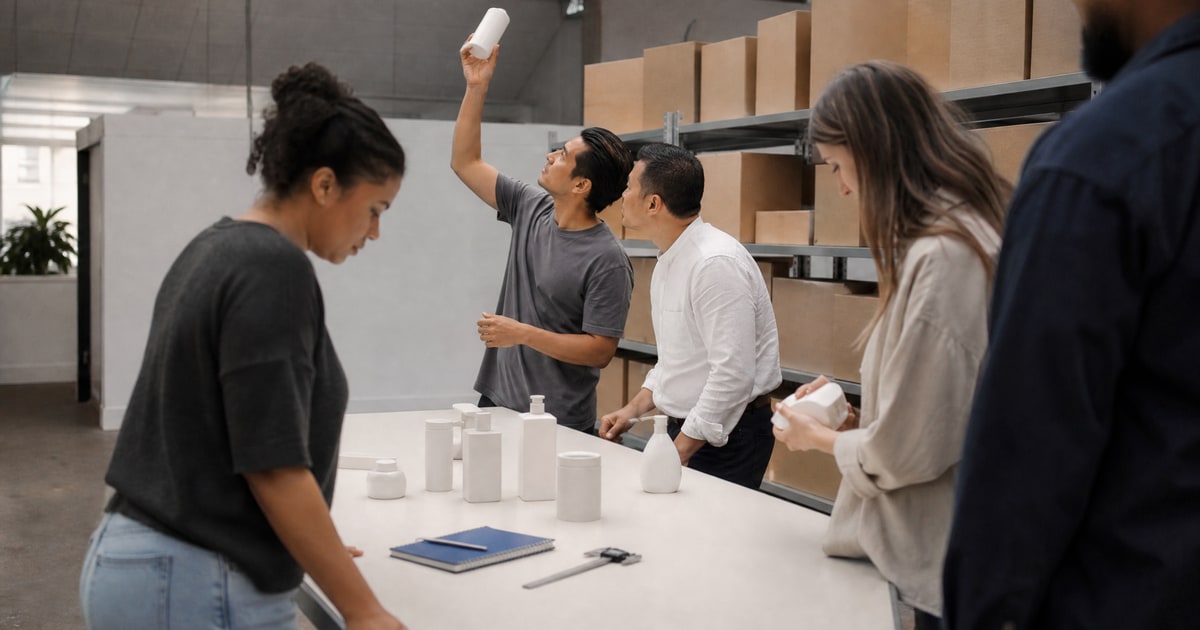
This is why we built an in-house sourcing and QC studio in Guangzhou. Our team handles factory vetting, production-line inspection, and pre-shipment verification. Nothing outsourced. We physically handle the products, run the quality checks, and verify compliance before anything ships.
OK so why does this matter for your specific situation? Return rate is one of the core kill criteria. A product with quality issues generates high returns, which kills profitability regardless of how well your ads perform or how strong your conversion rate is. Quality control is not a nice-to-have. It is your first defense against a return rate that triggers a kill decision.
Now let me break this down for sellers who do not have on-the-ground QC in China.
Use third-party inspection services for any China production run. Budget $200 to $400 per inspection. That is a fraction of what a failed production run will cost you.
Require pre-shipment photo and video documentation from your factory. Every unit, every carton, labeling closeups. If a factory resists providing this, that tells you everything you need to know about the relationship.
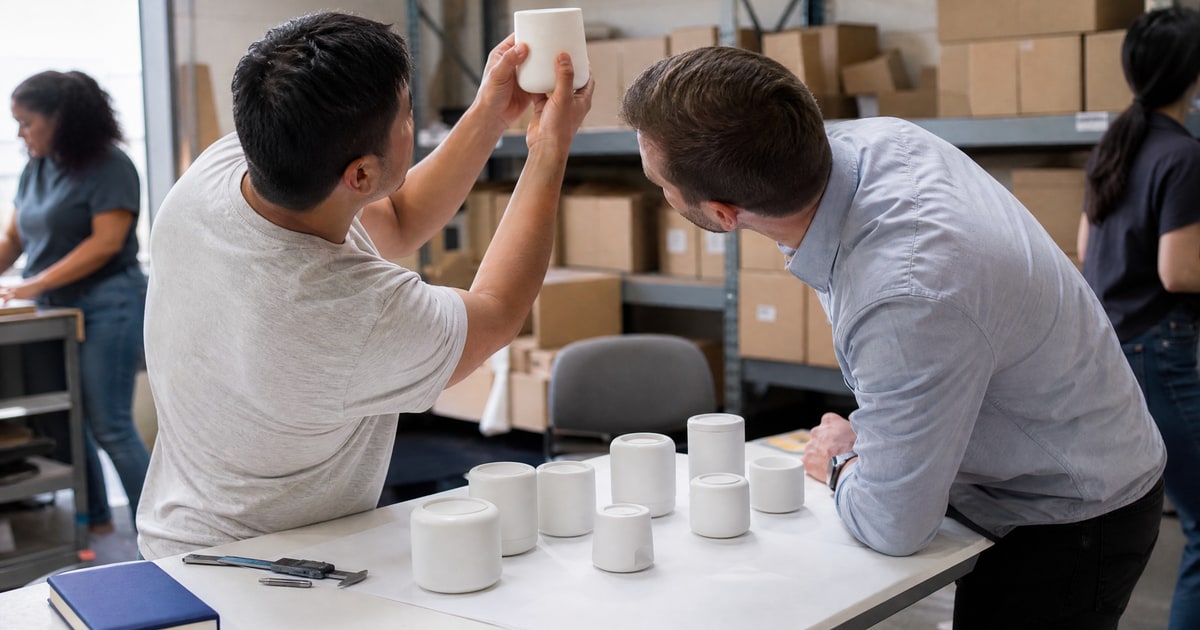
Run a test order before committing to full production. Order 50 to 100 units and inspect them personally. Compare against your approved sample. Check dimensions, materials, packaging integrity, and FBA compliance. This single step would have prevented the majority of sourcing-related failures I have seen across hundreds of brands. If you want those failure modes in detail, including the scams and quality traps that catch first-time importers, I covered them in how to source from China without getting burned.
The Cash Flow Math Most Sellers Ignore
Cash flow is the silent killer of Amazon businesses. Your sourcing decision is where cash flow risk starts.
Here is the math. Source domestically for Phase 1 and your capital is tied up for 2 to 4 weeks between order and units arriving at Amazon. Source from China and your capital is tied up for 8 to 12 weeks. For a seller with $5K to $10K in starting capital, that difference determines whether your business survives the validation period.
Now let me show you what this looks like with real data.
Say your Phase 1 budget is $7K and you are testing 2 products. Source from China and that $7K is locked for 10+ weeks before a single unit reaches Amazon. No revenue coming in. No data to evaluate. No flexibility to iterate. You are waiting. Your cash is gone.
Source domestically and you could have units on Amazon within 3 to 4 weeks. Within 6 to 8 weeks you have real sales data, real customer reviews, and real conversion rate numbers. You might even be reinvesting early revenue into your next test batch.
At scale in Phase 2, the cash flow gap is manageable because your validated product is generating revenue. You have data-proven demand, predictable sales velocity, and the cash flow to absorb a 10-week lead time. The gap does not disappear. It just becomes proportionate to a business that is already working.
If you want to run the numbers on your specific product idea, we built a profit forecast dashboard that calculates your P&L and cash flow at both Phase 1 and Phase 2 sourcing costs. Before choosing a supplier, model the economics. The cheapest per-unit cost is not the best sourcing decision if it starves your cash flow during the most critical window of your launch.
The Sourcing Mistakes I See Across 300+ Brands
Here is what actually goes wrong. Not scare tactics. The specific failure modes I see repeatedly, and how to prevent them.
Sourcing at scale before validating the product. This is the most expensive sourcing mistake. A seller finds a great factory, negotiates a volume discount on 1,000 units, commits $15K to $20K, and the product does not convert. Now they have 800 unsold units in an Amazon warehouse collecting storage fees. The sourcing decision was fine. The sequencing was wrong. Validate before you commit capital.
Relying on Alibaba listings instead of vetting the factory. Alibaba is a marketplace. Many "factories" listed there are actually trading companies that source from multiple manufacturers. You get inconsistent quality, no control over production, and higher per-unit costs because the trading company takes a margin. Ask for factory tour photos, business licenses, and verify whether they actually manufacture or just resell. Our supplier vetting guide covers the checks that separate a real manufacturer from a reseller, and I walk the process end to end in how to source products from China for Amazon FBA.
Not calculating all-in landed cost. The quote from your Chinese supplier is the production cost. It is not your actual per-unit cost. You need to add freight, customs duties and tariff overlays, clearance fees, Amazon FBA prep fees, and FBA fulfillment fees. On China-origin goods this is the line item that has moved most since I first wrote this piece: tariff treatment has shifted more than once, and the low-value shipment exemptions sellers used to lean on no longer work the way they did. Run your actual HS code through our tariff and import duty calculator for current rates instead of trusting a number you memorized last year, then use the landed cost guide to fold the result back into your margin. The "cheap" supplier in China might not be cheap once you calculate the full landed cost.
Emotional attachment to a supplier when the product fails. Kill criteria apply to sourcing decisions too. If your Phase 1 data shows the product is not viable, the fact that you found a great factory and built a good relationship does not change the data. The product fails or passes on its own merits. Sunk cost in supplier relationships is the same trap as sunk cost in inventory.
Here Is What to Do This Week
Before you contact a single supplier, run your numbers. Model your P&L with domestic sourcing costs for Phase 1. Then model it with China sourcing costs for Phase 2. If the Phase 1 numbers do not work with domestic supplier pricing, the product does not pass validation. Do not skip Phase 1 economics to chase Phase 2 margins.
Sourcing is not a China vs domestic decision. It is a validation vs scale decision. Match your sourcing strategy to your phase. Phase 1: speed and capital efficiency. Phase 2: unit economics and margin. The data from Phase 1 earns you the right to commit to Phase 2.
If you want to see exactly what a complete Amazon launch looks like from start to finish, including the sourcing step, I have put together a free launch roadmap that covers every step.
And if you want to run the numbers on your specific product idea, we built a profit forecast dashboard inside Flapen that calculates your chance of success, your P&L, and your cash flow. You can try it free.